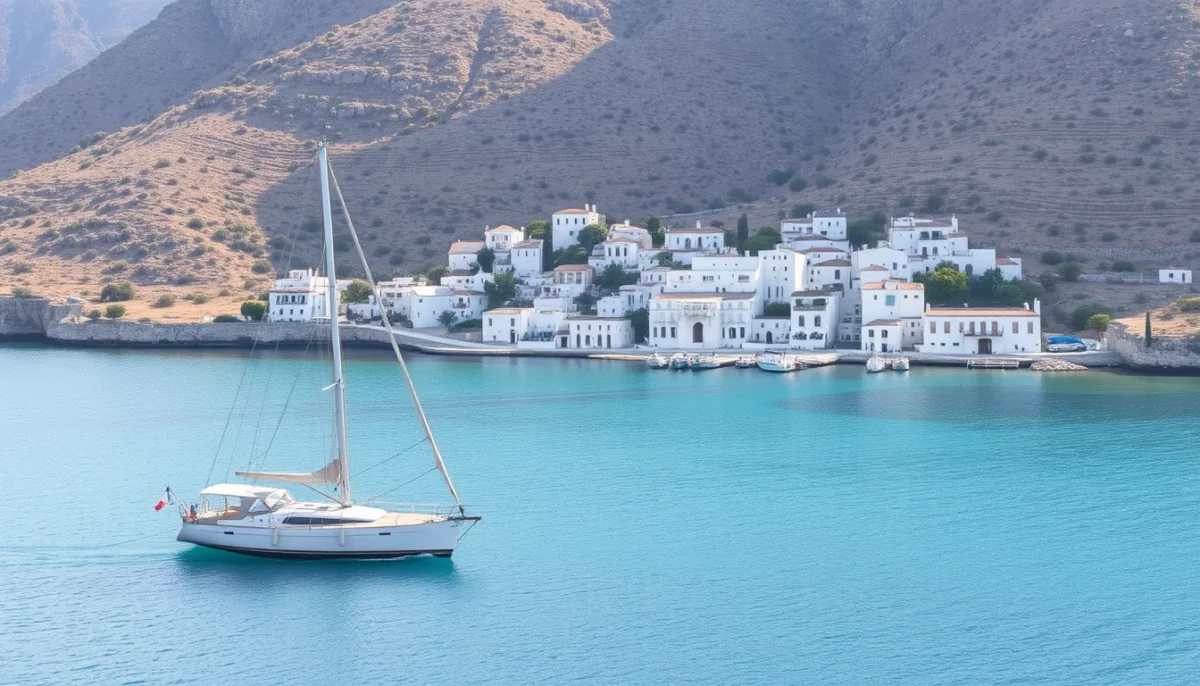
Many people who dream of sailing the Greek islands stop at the same question: do I need to know how to sail? For a growing number of travellers the answer is a professional skipper. A skipper turns a yacht holiday from a test of seamanship into a relaxed week at sea, but it also changes how the trip is planned, paid for and lived on board. This guide looks at when hiring a skipper makes sense in Greece and what to expect once one joins your boat.
Bareboat, skippered or crewed: the basic difference
Yacht charters usually fall into three formats. In a bareboat charter the vessel is handed over without crew, and the charterer navigates and takes legal responsibility for the voyage. In a skippered charter the yacht comes with a professional skipper or captain who is responsible for manoeuvring the boat. In a crewed charter there is a full crew, typically a captain, a chef, a deckhand and a hostess, and this format is most common on motor yachts and larger catamarans.
The skippered option sits in the middle. You keep the privacy and flexibility of your own yacht, while someone qualified handles the helm, the mooring and the daily decisions about weather and routes.
The licence question in Greece
Greek rules are the main reason many groups choose a skipper. For a bareboat charter, the person in command must hold an accepted qualification, such as the International Certificate of Competence (ICC), RYA Coastal Skipper or higher, or ASA 104. Charter companies note that the RYA Day Skipper has not been accepted by Greek port authorities since March 2019. On top of this, at least one second experienced adult crew member must appear on the crew list to assist with manoeuvres and mooring.
Charter companies also ask for the original licence card rather than a photocopy, a sailing résumé and a completed crew list before departure. If nobody in your group holds a recognised licence, or if only one person does and nobody can act as a competent second hand, hiring a professional skipper removes the requirement altogether.
Weather: the meltemi factor
The second reason is the wind. The meltemi is the strong northerly that blows over the Aegean mainly in July and August, with occasional episodes from late May to October. In open water it typically reaches force 6 to 8 on the Beaufort scale, and seas of 2 to 4 metres are common in the passages between the central Aegean islands. Mountainous islands can also produce sudden gusts on their lee side.
These conditions are manageable for experienced crews, but they can turn a short hop between the Cyclades into a demanding day. A local skipper knows which anchorages give shelter, when to leave early and when to stay in port. Sailing guides even suggest hiring a skipper at least for the first days if you are not used to meltemi conditions, or choosing calmer areas such as the Saronic Gulf.
What a skipper does and does not do
A skipper is responsible for the boat and for the safety of everyone on it. In practice that means planning the daily route with you, checking forecasts, handling the yacht in harbours and anchorages, and dealing with port formalities. Many guests also value the local knowledge: quiet bays, fishing villages and beaches that are hard to find in a guidebook.
A skipper is usually not a chef or a housekeeper. On a skippered charter, meals, provisioning and cleaning are generally up to the guests, unless you book a crewed yacht with a cook and hostess. It helps to clarify this before departure, together with whether the skipper prefers to hear the group’s plans the evening before or to set the route according to the weather.
If you want to try steering, raising sails or anchoring, say so. Many skippers are happy to teach, which makes a skippered yacht charter in Greece a good first step for people who hope to charter bareboat in later years.
Budgeting for a skipper
The skipper is an extra line in the budget. One European charter company quotes skipper fees in the region of 190 to 280 euros per day depending on the season, plus food. On most yachts the skipper also occupies a cabin, which reduces the number of berths available to guests, so a boat that sleeps eight might comfortably take six or seven guests plus the skipper.
Remember that the advertised charter rate is rarely the full cost. Fuel, marina fees, provisioning and optional extras are usually charged separately, and on crewed yachts there is often an advance provisioning allowance (APA) and a crew gratuity on top. Ask for a written quotation that lists what is included, so you can compare offers fairly.
Choosing the right area and boat
Greece offers several sailing regions, each with a different character. The Ionian and the Saronic Gulf are generally more sheltered and have short distances between harbours. The Cyclades are iconic but more exposed to the meltemi. The Dodecanese and the Sporades offer quieter routes and greener landscapes. A skipper can help match the region to your group’s experience and the season.
Boat choice matters too. Catamarans offer stability and space, which suits families and groups who prefer comfort at anchor. Motor yachts cover longer distances quickly and are useful when time is short. When comparing skippered yacht charters in the Greek islands, check the number of guests the yacht is rated for, the cabin layout including the skipper’s berth, and exactly what equipment and safety gear come with the boat.
Is a skipper right for you?
Hiring a skipper makes the most sense if nobody in your group holds a licence accepted in Greece, if you are sailing in July or August in the Aegean, or if you simply want to spend the week swimming and exploring rather than navigating. Experienced sailors with the right paperwork and a capable second crew member may prefer the freedom of bareboat. Either way, the key is to plan early, confirm the licence rules with the charter operator and agree on what is included before you step on board.
Sources
- Filovent, Boat licenses and boating in Greece: what you need to know before renting. https://www.filovent.com/us/faq/destinations/greece/boat-license-regulations-greece
- Sail Connections, What sailing qualifications are required for a bareboat charter in Greece? https://www.sailconnections.com/faq/what-sailing-qualifications-are-required-for-a-bareboat-charter-in-greece/
- Dream Yacht Charter, Mastering the Meltemi for Exhilarating Aegean Sailing in Greece. https://www.dreamyachtcharter.com/blog/mastering-the-meltemi-for-exhilarating-aegean-sailing-in-greece/
- Wikipedia, Yacht charter. https://en.wikipedia.org/wiki/Yacht_charter
Σχετικοί οδηγοί
 Concierge in Mykonos: what it handles and how to brief itMykonos is a small island with a very large reputation. Encyclopaedia Britannica puts its area at…
 Vathy, Samos: A Heritage Walk Through the Island CapitalMost visitors arrive in Samos through Vathy, the island capital that sits at the head of…
Βρήκατε κάτι λάθος;
Αν κάποιο στοιχείο εδώ έχει αλλάξει ή είναι ανακριβές, η διόρθωση αξίζει περισσότερο από το αρχικό κείμενο.
Στείλτε μας διόρθωση